The Joy of Embodied Learning
10th November 2025 by Farhana Khan
The Embodied Learning: The Relationship between Mind and Body.
The process of learning has actually been considered a purely intellectual form of learning; a process that occurs in the head by reading, writing, memorizing and reasoning. The idea of embodied learning however questions this narrow perspective by pointing out that the body is a critical component in the way we learn, experience and remember. Such a term as embodied learning is based on the notion that thinking and learning are not independent of the physical body, rather closely linked to movement, sensations, emotions, and environmental interaction.
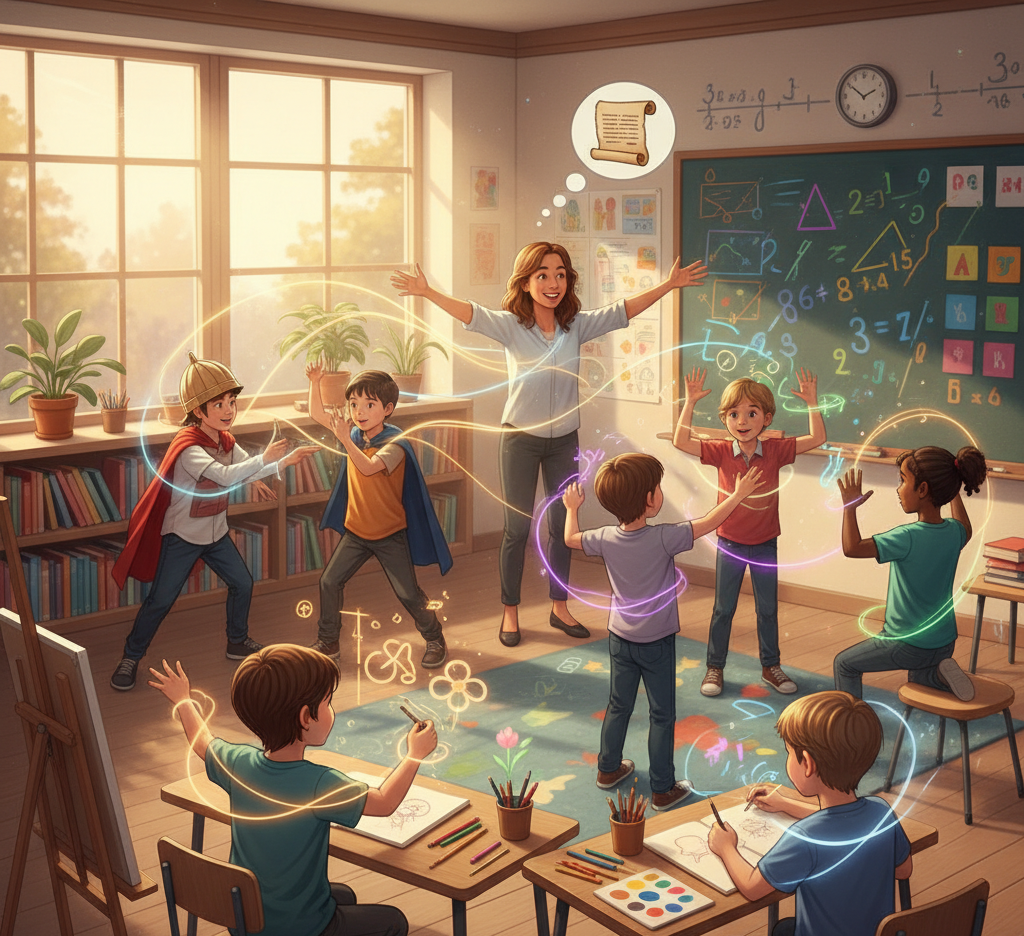
Children are supposed to study by reading, using books and listening to lectures with little physical activities. This system is an accidental separation of the body and the mind which makes the learning only passive. On the contrary, embodied learning focuses on engagement - the need to involve learners in the process of learning by allowing them to make gestures, move physically, and engage with their emotions. In fact, when learners role-play a historical event or use their hands to illustrate mathematical ideas, do art and drama they are not merely memorizing anything but they are touching and feeling the information.
Studies of cognitive science back the thinking that the body and the brain are not separate but rather, they make one learning system, which is integrated. Movement and sensations build neural pathways making them more creative, memory-wise and problem-solvable. Thus, embodied learning reinstates an equilibrium which cannot always exist in a traditional classroom setting - learners are able to think, feel, and move as a single entity. Such a combined method fosters curiosity, interest, and emotional intelligence, which cause more significant learning experiences.
Emotional and Social Aspects of Embodied Learning.
Embodied learning does not only concern the physical movement; it is also concerned with the presence of emotion and social relationship. Human beings are most able to learn in an environment where they feel secure, visible, and touched. Learners become more committed and enthusiastic when they are fascinated to carry their feelings, identities, and personal experiences with them to the learning process. Emotions, such as joy, curiosity and empathy are effective emotional drivers that can turn the learning experience to be not only about acquiring knowledge but about becoming a person.
Embodied learning tutors understand that learning occurs within relationships, the teacher student relationship as well as student to student relationship. The community and a sense of belonging in the classroom can be achieved through simple activities such as group work, breathing exercises, and storytelling. The learner can freely express himself or herself physically and emotionally; this means the learner is likely to take risks, ask questions and explore things freely.
Inclusivity is also promoted in the social side of embodied learning. Traditional academic environments prove to be challenging to a large number of students particularly those with different learning styles. Embodied learning also provides various ways of knowing, auditory, visual, and kinesthetic, emotional and enables all learners to participate by their strength. A learner with a poor command of either spoken language can describe something visually, or he/she can find some form of movement or role playing to present the same and feel confident and clear.
Besides, the emotional aspect of embodied learning helps to develop empathy and self-awareness. As an example, when students are involved in a drama activity and play various social scenarios, they get to learn how other people would view the world. This leads to emotional intelligence, which is an important skill in the modern globalized and diversified world. By appealing to emotions, learners will gain resilience, compassion, and deeper understanding, which will not just be limited to academics but to all aspects of life.
Essentially, embodied learning will help to turn classrooms into the place where the hearts and minds collaborate. It is a way of education to reach the entire person, to develop not only intellectual adequacy, but also emotional maturity and social harmony. Connection is thus the source of the pleasure in learning, with connection to oneself and to others, and connection to the world of ideas.
Embodied Learning: Practices and Benefits in Modern Education.
Embodied learning is becoming increasingly used in modern education, both in early childhood education and in higher education. Tutors understand that learners learn more when they use their bodies in addition to their minds. Examples of movement-based learning include a way to internalize abstract concepts by younger children. Knowledge is referenced and retained through simple tasks such as walking number lines in mathematics or simulating the process of plant growth by playing an act in science classes. These tactics arouse the senses and create more attention and memorability.
Embodied learning may be in the form of reflective practices, experiences in higher education, and arts-based pedagogy. As an example, literature students can examine characters by role-playing, and medical students can use the interaction with simulated patients to experience empathy and communication. Mindful pauses, stretching exercises, and body awareness activities are appropriate in the virtual and in both online and hybrid learning settings, to ensure the engagement and minimize fatigue, to close the divide between the virtual and the physical.
The advantages of embodied learning have both cognitive and emotional aspects. It improves memory, concentration and creative problem solving cognitively. In the emotional aspect, it decreases anxiety, develops confidence and also creates intrinsic motivation. Physically, it is healthy and well because it offsets the sitting-down-ness of the present-day classrooms. Students can enjoy and experience learning when they are on the move, interact and express themselves freely as opposed to being rigid and mechanical with learning.
The other benefit of embodied learning is that it encourages presence and mindfulness. Mindfulness, or the process of paying attention to one’s body, breath, and sensations, can assist learners in paying more attention to their surroundings and in coping with stress. Educators who incorporate mindfulness in their classes help students to take a break, contemplate, and become aware of their interiority. This does not only enhance learning results but also develops emotional control and self-discipline.
Besides, embodied learning is consistent with the aim of education as a whole. Education does not only deal with passing information but also the making of individuals capable of critical thinking, responsible actions and meaningful living. Identifying the body as an essential location of knowledge, teachers also enable students to become more agentic and self-reflective. They are taught that wisdom does not dwell in the mind only but is also in the body - in the manner in which we move, relate, perceive the world.
The embodied learning transformation can be seen in the classrooms that place importance on classes that focus more on the play, movement, reflection and dialogue. These areas are occupied with life — laughter, inquisitiveness, and exploration. The pleasure of discovery will be a reward by itself when the learners take pleasure in the process. This happiness encourages life long learning as well as inquisitiveness outside the classroom.
Conclusion
Embodied learning is seen to bring the delight of understanding the entire human being: mind, body, and heart as an active part of the educational process. It goes beyond the confined concept of learning taking place solely in the brain, and recreates the natural substance between thinking, feeling, and bodily experience. Embodied learning allows making learning more inclusive, meaningful, and joyful by tapping into the senses, creating an emotional connection, and enhancing mindful presence.
Embodied learning challenges teachers and students to revert to the abundance of lived experience in a world that is more screen dominated, more abstract, more disconnected. And it is to remember that learning is not merely to know but to be - to be conscious, and living, active, in touch. Learning turns into a celebration of life itself when the body is involved in learning, as opposed to acting as a silent spectator. Embodied learning is not merely the joy of knowing something, but of sensing it, communicating it and perceiving it in all the movements, inhalations and interactions.
Categories : english ,health ,languages ,learning-difficulties