How Students Can Balance Tech and Study Time in 2025
28th October 2025 by Farhana Khan
Students are now permanent companions of technology in the constantly changing world of 2025. Technology has transformed learning by making it more interactive and more accessible than ever before through the use of AI-powered study tools, virtual classrooms, among others. However, there is a challenge to this convenience, and that is balance. It is on the thin side of what is considered productive use of technology and unhealthy overdependence, and students are usually distracted by what should be considered their help. Learning to use technology and study time is now a critical ability in becoming a successful student and in having a healthy mind and body.
1. The Two-Sided Sword of Technology in Education.
Everything has been transformed by technology in education. It enables students to access international knowledge in a matter of seconds, learn anywhere, and work internationally. Students in 2025 do not necessarily have to rely on traditional textbooks or in-person lectures because they have access to platforms such as Google Classrooms, Zoom, or ChatGPT-powered study assistants. Nevertheless, as much as these tools enhance efficiency in learning, they are very dangerous when used or even abused.
Digital distraction is one of the largest problems. Online games, social media, and entertainment applications tend to rival the attention of students. A student will sit down in front of a laptop to conduct research and can spend hours browsing through short-form videos. In numerous educational research studies, attention is becoming smaller because of continuous exposure to instant digital satisfaction. It becomes difficult to have the students remain focused on reading or long-form learning materials.
The other problem is information overload. Students have unlimited data on the internet, which may overwhelm them with the option. They can read through various materials and fail to comprehend and internalize information, instead of deep learning.
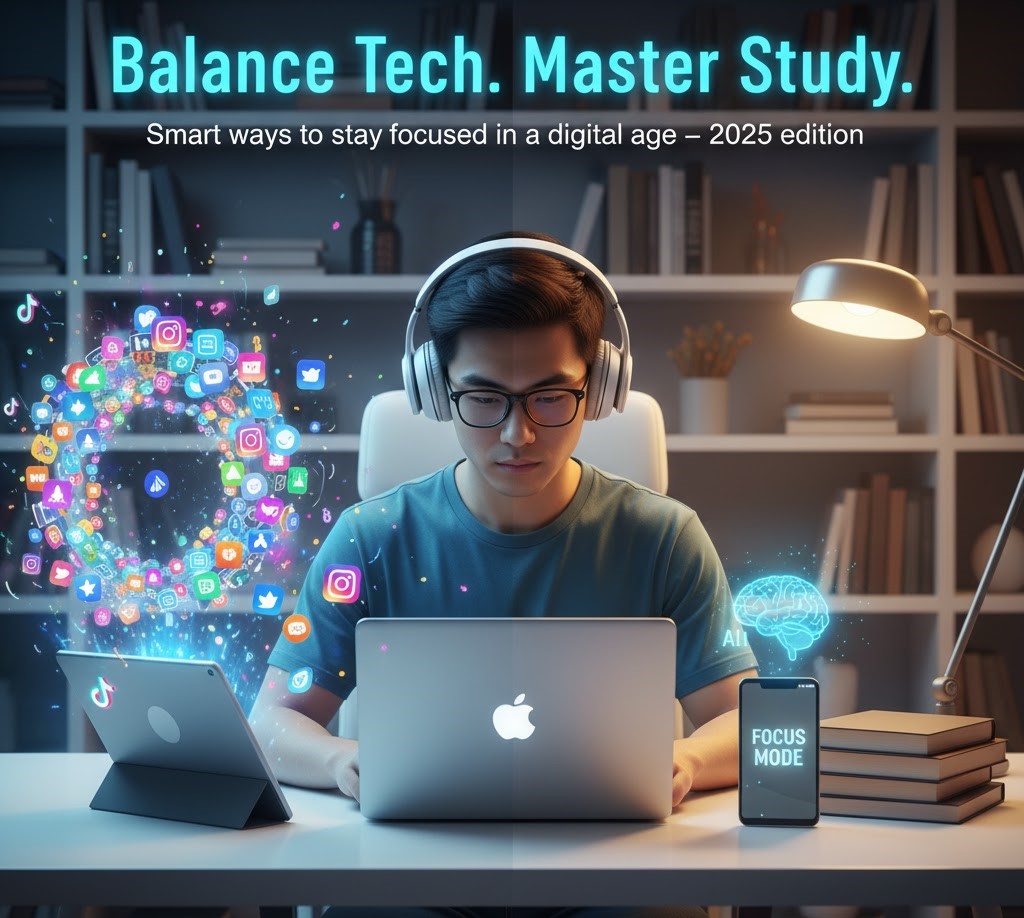
2. Easy Measures To Work-Life Balance between Technology and Study.
Bringing balance between technology and study time is done deliberately and with habitual practices. There are a number of strategies that the students can embrace in an attempt to make technology serve them and not dominate them.
Develop a Study Plan and Adhere to It.
Balance is based on an articulated schedule. Students are advised to create a block of study, student breaks, and digital leisure. For personalized guidance and professional tutoring support, they can explore The Tutors Directory to connect with qualified tutors who help build effective study routines. This strategy will reduce any distractions and will establish a schedule in which the brain is aware of when to be attentive and when to take a break.
Learn with Technology-Not to escape.
Technology may serve as an instructor and a snare. It is the trick to find the tools that will really contribute value. Efficient studying may be facilitated with the help of apps like Notion, Trello, or Quizlet which allow taking notes, organizing time, and visualizing concepts. AI study assistants could also be used by students to summarize complicated materials or to produce practice questions.
Practice Digital Detox
In a highly connected world, occasionally, all the students do is disconnect. A digital detox does not mean that one simply stops using any technology, but instead, they spend some time without being attached to any devices, e.g. an hour before going to bed or on Sundays afternoons, when they turn the devices off. During this time, students can read, play or outdoor.These offline experiences are a renewal of the mind, better sleep, and concentration when studying.
Train to sort and sieve out information.
With the internet flooded with information, students have the responsibility to know how to sieve the information on what is right and what is wrong. Credible academic publications, journals, and the official educational websites will aid in saving time and improving the quality of the research findings. Citation generators and academic databases are some of the tools that can be used to simplify the learning process without spending hours searching untrustworthy information.
Practice Mindful Screen Use
Mindfulness refers to the attention to what one is doing at a particular time. This can be implemented by the students checking their interaction with devices. They are able to ask: Is this contributing to my study goal? before opening a new app. The first thing to do before the use of technology is to have clear objectives so as to reduce aimless surfing. In addition, eye strain can be reduced with the help of blue-light filters or by altering the screen brightness in case for a long time of studying.
Virtual and Real Interaction Balance.
Online learning communities are desirable yet the students are not supposed to miss out on face to face social interaction. The interpersonal skills may be enhanced when a person learns in groups, volunteering, or when they take part in the activities occurring on the campus, and it will lead to a decrease in screen addiction. Real conversations provide emotional support and the perspective that can never be substituted by an app.
Management of Sleep and Physical Health.
Technology must be used to strengthen, not to weaken, health. The use of late-night screens may lead to sleep disturbance that results in sleepiness and decreased productivity among students. The establishment of a digital sunset will be beneficial to rest, which means no screens after this time. On the same note, regular physical activity, such as a brisk walk, enhances concentration and less stress as a result of prolonged digital interaction.
These plans are not restrictive only but about conscious involvement. Having technology as a partner in learning and not a hindrance is achieved when it is applied purposefully.
3. The Role of Self-Discipline and Awareness in Digital Balance
They can be influenced by tools and techniques, yet it is up to us to make the correct choice to embrace the tool effectively. The ability of the human to control impulses is even more important in 2025 when AI assistants are capable of setting the schedule and analyzing studying habits. When one is able to accomplish something without being distracted, the resulting satisfaction leads to strengthening positive behavior.
Consciousness is also significant. The students will have to consider their practices on a periodic basis: How much time do I spend on screens every day? Am I studying with technology or evading studying with technology? Digital record keeping, whether it is a diary or screen-time monitoring, may give a clue as to where time is being wasted.
Institutions, teachers, and parents have a role to play in the guidance of students. Schools can contribute to the technological equilibrium by supporting blended learning, which is a form of traditional reading and discussions that are being supported by digital tools. Students can be provided with lifelong digital well-being, focus, and responsible media use workshops.
Meanwhile, it is paramount to consider the fact that technology is moving in the direction of encouraging balance. A lot of new applications are now associated with such features as focus mode or study analytics to allow students to plan their time better. In 2025, AI-based applications will go as far as to warn the user whenever they are spending too much time on the Internet or when they lose focus. Therefore, the tools themselves are learning to promote healthy activities- but they will do it only when users are collaborating with them.
The future will be of the people who are capable of critical thinking and positive actions. Learners who adopt a self-managing habit and conscious use of technology will not just achieve higher grades, but will also be able to regulate their emotions in a digital-intensive global environment.
.jpg)
Conclusion
Technology is a gift, but like all gifts, its value is determined by its use. In the year 2025, when all students have abandoned their backpacks in favor of a screen and all libraries are substituted with an application, access is not a problem, but rather control. The students should be taught to be the controllers, and not the slaves, of technology. They can balance the digital tools by establishing limits, forming routines, and staying mindful so that they do not become masters of their learning.
It is not about denying technology but applying it in the most intelligent way possible, to merge its pace with human attention, its information with human intelligence. A moderate lifestyle ensures academic performance as well as mental purity and wellness. Having this type of balance, students will not only be capable of following up on the future, but also be able to make it.
Among students willing to enhance their habits of learning and study methods, there is a way to find professional tutors that could assist them to cope with technology and use study time efficiently at The Tutors Directory.
Categories : education ,learning-difficulties ,online-tuition